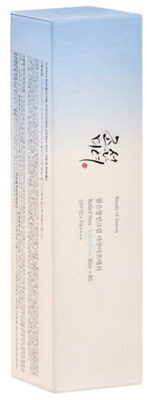
Beauty of Joseon
Relief Sun: Rice + Probiotics SPF 50+
Every morning · yes, also in winterThe one to start with. No white cast, no heavy feel, and the only sunscreen on this list that behaves in a beard.
approx. $18View details
Why sunscreen leaves a white cast, which types avoid it, and what to pick if you have a beard.
The white cast is the single biggest reason men give up on sunscreen. It is also the most solvable problem in this entire category, because it comes from one specific thing.
Once you know what causes it, picking one that disappears on your skin takes about a minute.
Mineral filters, mostly zinc oxide and titanium dioxide, stay on the surface of the skin rather than being taken up into it. The particles scatter visible light, and that is what you see as a pale film, more noticeable the deeper your skin tone.
A common explanation says these filters work by reflecting UV away like a mirror. That is not really accurate: they protect mainly by absorbing UV, much as chemical filters do. The practical difference is where they sit, not how they neutralise the light.
Modern chemical filters are taken up into the top layer of skin and leave nothing visible. They are not harsher by definition, they simply behave differently on the skin. Most of the sunscreens people describe as invisible are chemical.
The first is a modern chemical filter, usually from a Korean or European formula. These tend to be thin, sink in within a minute and leave no colour at all.
The second is a tint. Iron oxides in the formula cancel the pale film, which is why a tinted mineral sunscreen can suit people who react to chemical filters and still refuse to look pale. A tint is one colour though, so check it in daylight before buying a big bottle.
What does not work is using less to avoid the cast. Sunscreen is tested at a specific amount, and applying a thin layer to keep it invisible costs you more protection than the cast was ever worth.
This changes the answer. Thicker sunscreens leave white residue at the base of facial hair that is visible from a metre away and does not rub in.
What works is a thin, fluid texture applied to the skin before the hair, in small amounts, worked in with fingertips rather than palms. A dewy Korean formula generally behaves better here than a thick mineral one.
Most people apply roughly a third of what the SPF number was tested with. An SPF 50 applied thinly does not perform like SPF 50.
Two fingers worth for face and neck is the usual guide, and it will feel like more than you expect. If a sunscreen is so heavy that you cannot bring yourself to use that much, that sunscreen is the wrong one, no matter how good the reviews are.
Pick by texture first and by brand second. The best sunscreen is the one you will actually put on every morning, and for most men that is a thin one without a tint problem.
The one to start with. No white cast, no heavy feel, and the only sunscreen on this list that behaves in a beard.
Built for skin that goes shiny. Matte finish, oil absorbing, no dewy look.
Mineral filters plus a tint. The combination that solves both the stinging and the white cast at once.
Expensive, and worth a look if your skin has reacted to other sunscreens.